


Last Updated: November 21, 2026
Quick Summary
Dental furnace settings for zirconia restorations should follow the sintering curve supplied by the zirconia maker, with peak temperature commonly around 1450°C to 1550°C depending on the material. Slow the ramp for thick sections and multi-unit bridges, and use controlled cooling to prevent cracking.
- A programme that runs too cool leaves a porous, weak zirconia unit.
- Thin or highly translucent units should sit at the lower end of the maker's range.
- Slow the ramp 20-30% for long-span bridges of 4 or more units.
- Calibrate at commissioning and every three to six months during normal use.
- A deviation of roughly 10°C at peak temperature can change shade-sensitive units.
Table of Contents
- Why Sintering Settings Decide the Fit and Shade of Every Zirconia Unit
- Building a Zirconia Sintering Schedule That Matches the Material
- Settings by Restoration Type, Thickness and Unit Count
- Rapid Sintering Zirconia: What You Gain and What You Give Up
- Dental Zirconia Furnace Calibration You Can Verify Yourself
- Zirconia Sintering Defects and the Settings That Cause Them
- Programming Your Furnace and Loading the Chamber Correctly
- Choosing a Sintering Furnace That Holds Its Settings
- Frequently Asked Questions
Why Sintering Settings Decide the Fit and Shade of Every Zirconia Unit
Get the dental furnace settings for zirconia restorations wrong and you lose the case twice: once in the furnace, and again when the crown comes back.
Sintering is the controlled heating of a milled zirconia restoration to a peak temperature, holding it there, then cooling it down. The programme drives shrinkage, density and translucency.
Three things follow from that:
- A programme that runs too cool leaves a porous, weak unit.
- A programme that heats too fast can crack or distort the crown.
- A programme that cools too fast can lock in stress that shows up days later.
Below, we walk through a practical workflow: matching a schedule to the material, setting temperature and hold time, calibrating the furnace, and reading defects back to the parameter that caused them.
Building a Zirconia Sintering Schedule That Matches the Material
Start with the material, not the furnace. Every zirconia disc ships with a recommended sintering curve from its maker. That curve is the baseline.
A zirconia sintering schedule is the full sequence of ramp, peak, hold and cooling steps for a given material.
The Nobilcam MM-4D MaxMultilayer Zirconia Discs, for example, carry their own sintering instructions, and those instructions should drive the programme.
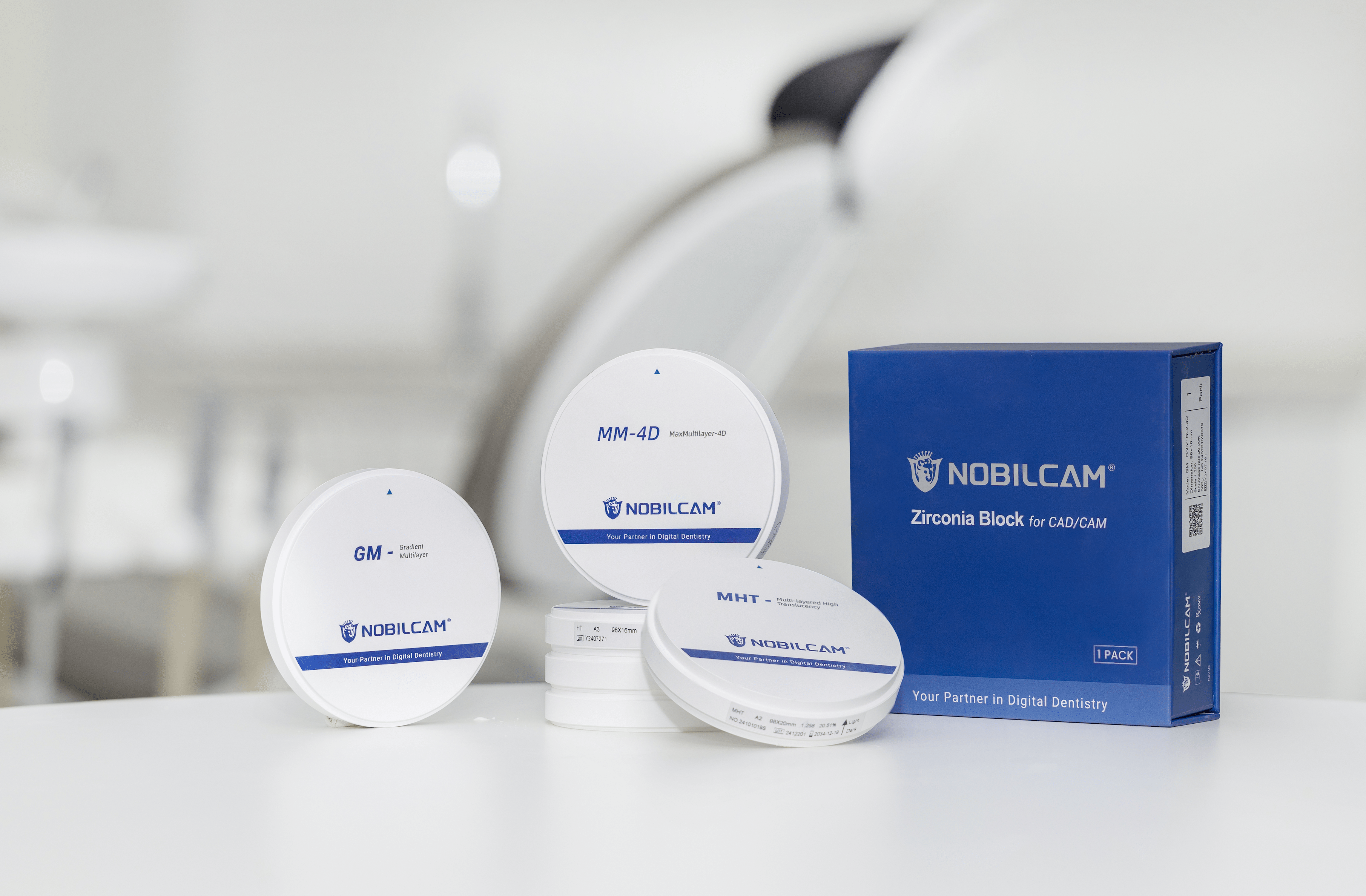
Heating Rate, Peak Temperature and Hold Time in Sequence
Think of the cycle in three stages: the heating rate (ramp rate) climbs from room temperature to peak; the hold time (dwell time) keeps the chamber at peak; cooling brings it back down in a controlled way.
- Heating rate: a slower ramp lets heat reach the core of thicker units; a fast ramp risks a temperature gap between surface and centre.
- Peak temperature: this drives final density and translucency, usually in the high range the maker specifies, commonly around 1450°C to 1550°C depending on the material.
- Hold time: too short and the core stays under-fired; too long and you can over-sinter, which can hurt translucency and shade.
Enter each stage exactly as the maker lists it. Do not round a peak temperature up "to be safe". That is how shades drift.
Cooling Down Without Cracking the Restoration
Cooling is the stage most labs rush. Controlled cooling brings the restoration down at a set rate; natural cooling lets the chamber fall to room temperature on its own.
Fast cooling can create a temperature difference between the outside and inside of a unit, building stress that can show as cracking. If your furnace offers a controlled cooling step, use it.
Settings by Restoration Type, Thickness and Unit Count
Thickness and unit count change what the programme has to cope with.
Use the table below as a decision aid, then confirm every value against the zirconia maker's curve.
| Restoration type | Typical wall thickness | Ramp adjustment vs maker's standard | Peak temperature | Hold | Cooling |
|---|---|---|---|---|---|
| Single crown, standard | 0.8-1.2 mm | Standard | Maker's spec (commonly 1450-1500°C for 3Y) | Maker's spec (commonly 120 min) | Controlled, 3-5°C/min |
| Thin or highly translucent unit | Under 0.8 mm | Standard to slightly slower | Lower end of maker's range | Do not extend | Controlled |
| Inlay or onlay | 1.0-1.5 mm | Standard | Maker's spec | Maker's spec | Controlled |
| 3-unit bridge | 1.0-1.5 mm per unit | 10-20% slower | Maker's spec | Maker's spec | Controlled |
| Long-span bridge (4+ units) | 1.0-1.5 mm per unit | 20-30% slower | Maker's spec | Maker's spec | Controlled, slower |
| Full-arch or thick section (over 2 mm) | Over 2 mm | Slowest the maker allows | Maker's spec | Maker's spec | Controlled, slowest |
| Full chamber load | Mixed | Standard to slower | Maker's spec | Maker's spec | Controlled |
Three mechanisms sit behind those adjustments.
Peak temperature sensitivity in thin units. Thin and highly translucent units have little material to absorb overshoot.
Chamber load effect. A full chamber absorbs heat differently from a near-empty one. Because chamber capacity and load arrangement shape the thermal profile, compare furnace options through the Buy & Sell Market when planning a consistent sintering setup.
Watch out: treating the maker's peak temperature as a target to hit exactly regardless of thickness.
For multi-layer discs, thickness also interacts with the shade gradient built into the disc.
Rapid Sintering Zirconia: What You Gain and What You Give Up
Rapid sintering zirconia trades cycle time for control.
The gain is turnaround. The trade-off is a narrower margin for error. Speed programmes push heating and cooling harder, so the material must be rated for it and the furnace must hold temperature accurately.
If speed is central to your workflow, look at a furnace built for it. The Nabertherm LHT 02/17 LB Speed Furnace uses a motor-driven lift table and a forced cooling function, and under program control it can reach total cycle times of less than two and a half hours depending on the batch.
Best for: labs with tight turnaround and material rated for speed cycles. Skip if: your zirconia maker specifies a standard curve only.
Dental Zirconia Furnace Calibration You Can Verify Yourself
Dental zirconia furnace calibration confirms that the temperature the controller shows matches the real chamber temperature. A furnace that reads 1500°C but delivers 1470°C will under-fire every load, quietly.
How Often to Calibrate
A practical interval most labs settle on is:
- At commissioning, before the first production load.
- Every three to six months during normal use, depending on throughput.
- After any heating-element change, thermocouple replacement, or service that opens the chamber.
- After a move or any event that could disturb the chamber or controller.
High-throughput labs running rapid cycles should sit at the shorter end of that interval because the furnace spends more time at peak temperature and elements age faster.
Running the Check
- Use a calibration ring or test piece of known behaviour and fire it on your standard programme.
- Inspect the result for under- or over-firing signs: chalky surface, poor density, or a shade that reads too light or too opaque.
- Log the outcome against the date, programme used, and furnace ID so you can spot drift over time.
- Record process data where the furnace allows it. The Nabertherm controllers support NTLog Basic for recording process data to a USB flash drive.
Interpreting the Result and Acceptable Deviation
A test piece that fires correctly confirms the furnace is holding its programme within the tolerance the material can absorb. One that under- or over-fires indicates the chamber temperature has drifted from the setpoint.
As a working rule, a deviation of roughly 10°C from setpoint at peak temperature is enough to change the outcome on shade-sensitive and thin units, and larger deviations will show on standard crowns.
Corrective Action
- Confirm the programme first. A mis-entered peak or hold will mimic a calibration fault.
- Check the thermocouple and its position. A displaced or degraded thermocouple reads the wrong temperature.
- Check the heating elements for ageing or uneven output.
- Adjust the controller offset only if the furnace supports it and you have a documented procedure; otherwise call service.
- Re-run the test piece after any change and log the new result before returning to production.
Watch out: adjusting the material or the programme to compensate for a furnace that is drifting. That masks the fault and moves the error into every subsequent load.
If a test piece comes out wrong, do not adjust the material. Check the furnace first. Temperature accuracy is the foundation everything else sits on.
Zirconia Sintering Defects and the Settings That Cause Them
Most zirconia sintering defects trace back to a specific parameter. Read the symptom, then check the setting.
Chalking, Cracking and Distortion: Matching the Symptom to the Parameter
- Chalking or a powdery, opaque surface: usually under-firing. Check peak temperature and hold time against the maker's curve.
- Cracking after firing: often too-fast heating or cooling. Slow the ramp and use controlled cooling.
- Distortion or slump: over-firing, or a peak temperature set too high for the unit's thickness.
- Shade too light or too opaque: peak temperature or hold time drifting from spec, or a calibration problem.
- Poor density and weak units: too short a hold, or a chamber that never reached peak.
Watch out: changing two parameters at once when a defect appears. You will not know which change fixed it, and you may mask a calibration fault. Change one thing, re-fire a test, then judge.
Programming Your Furnace and Loading the Chamber Correctly
A good programme still fails in a badly loaded chamber. Loading affects how evenly heat reaches each unit.
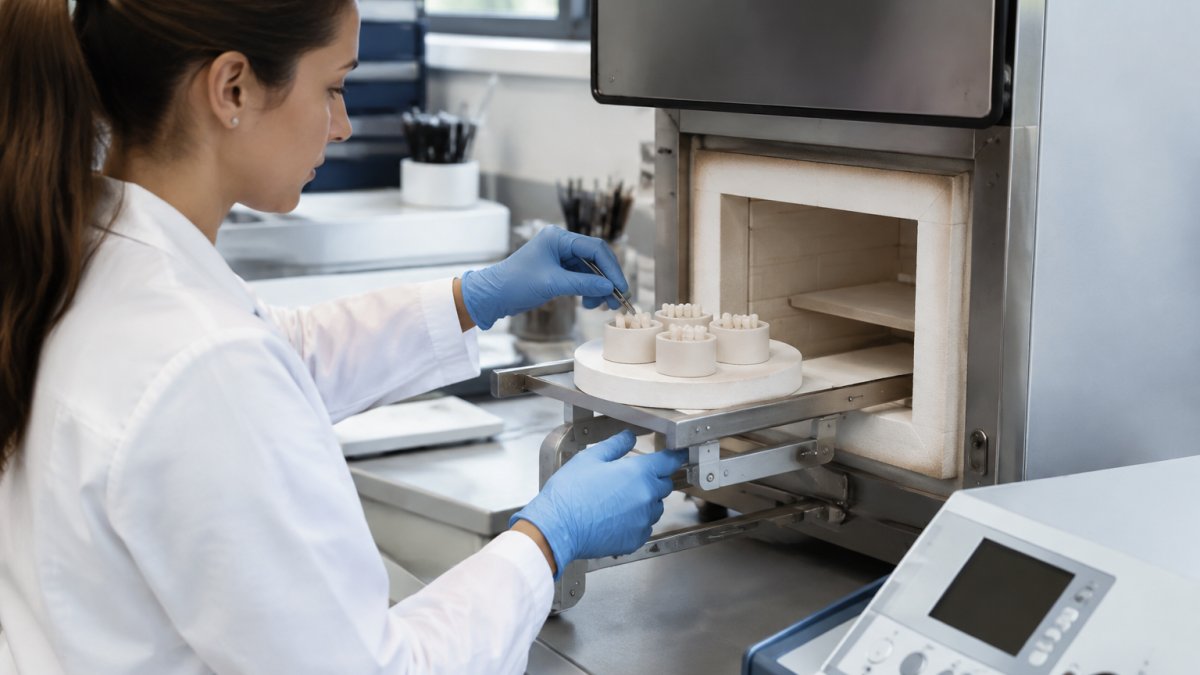
Follow this sequence:
- Select the correct stored programme for the material.
- Confirm peak temperature and hold time against the maker's curve.
- Load units into ceramic saggars, spaced so they do not touch.
- Keep units on one level unless the furnace supports additional levels.
- Close the chamber fully and start the cycle.
- Leave the chamber closed through cooling.
The Nabertherm LHT 03/17 D and LHT 01/17 D can be charged with up to three or two saggars respectively, with 15 or 25 individual crowns per level depending on model. Spacing units correctly is not optional; it is part of the programme.
Choosing a Sintering Furnace That Holds Its Settings
The best programme is only as good as the furnace running it. When you buy, judge a furnace on one question: does it hold its programmed settings load after load?
Look for:
- Accurate temperature control across the full range, including the lower range used for drying.
- Programme memory so your curves are stored, not re-entered by hand.
- Even temperature distribution across the chamber.
- Process data logging so you can prove what the furnace actually did.
For labs that want a concrete model to evaluate, the Nabertherm LHT 03/17 D offers a 1650°C maximum, molybdenum disilicide heating elements and a controller with memory for 50 programs. The Nabertherm LHT 01/17 D brings the same control into a smaller footprint. If you are still at the buying stage, our guide on how to choose a dental laboratory furnace for zirconia sintering walks through the decision in more depth.
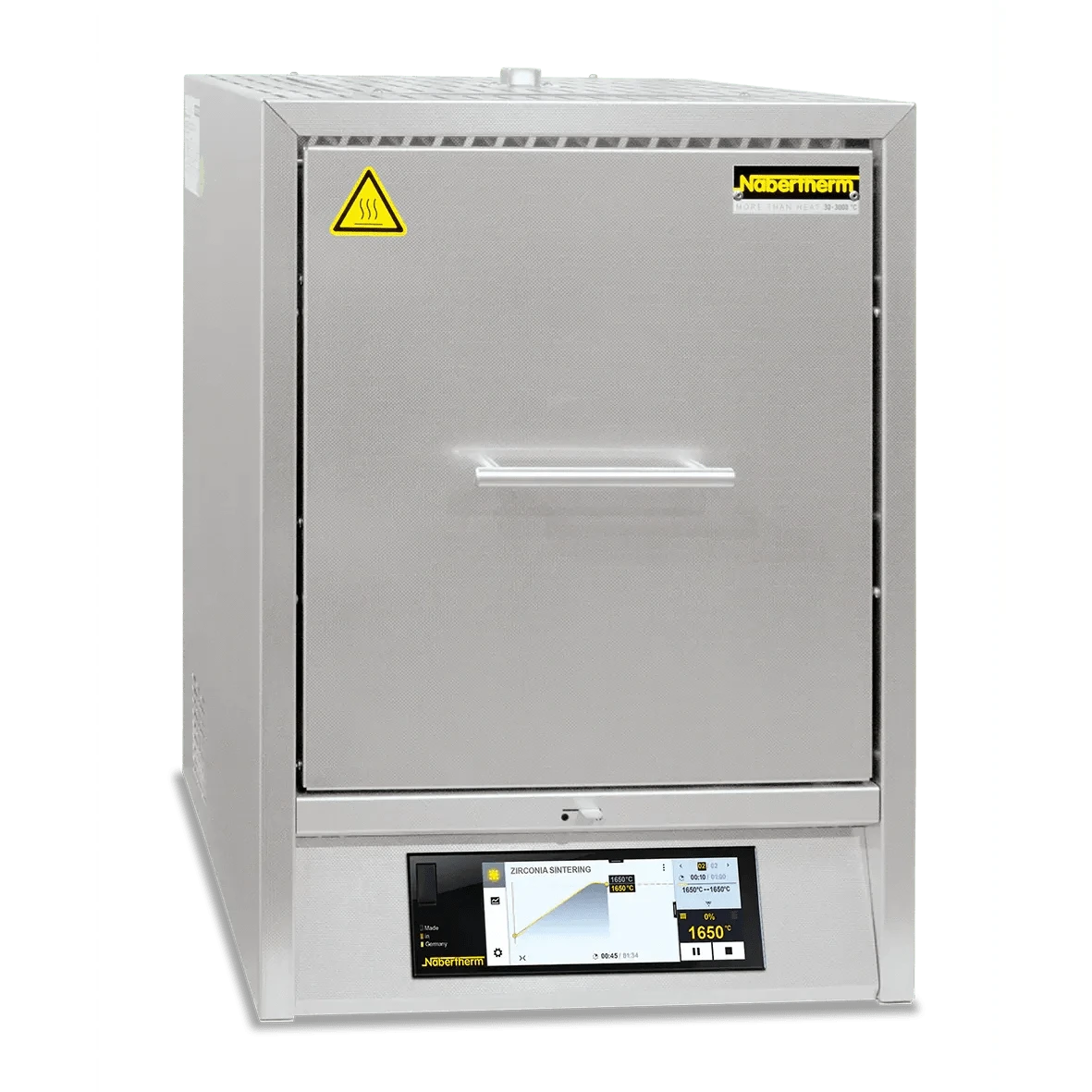
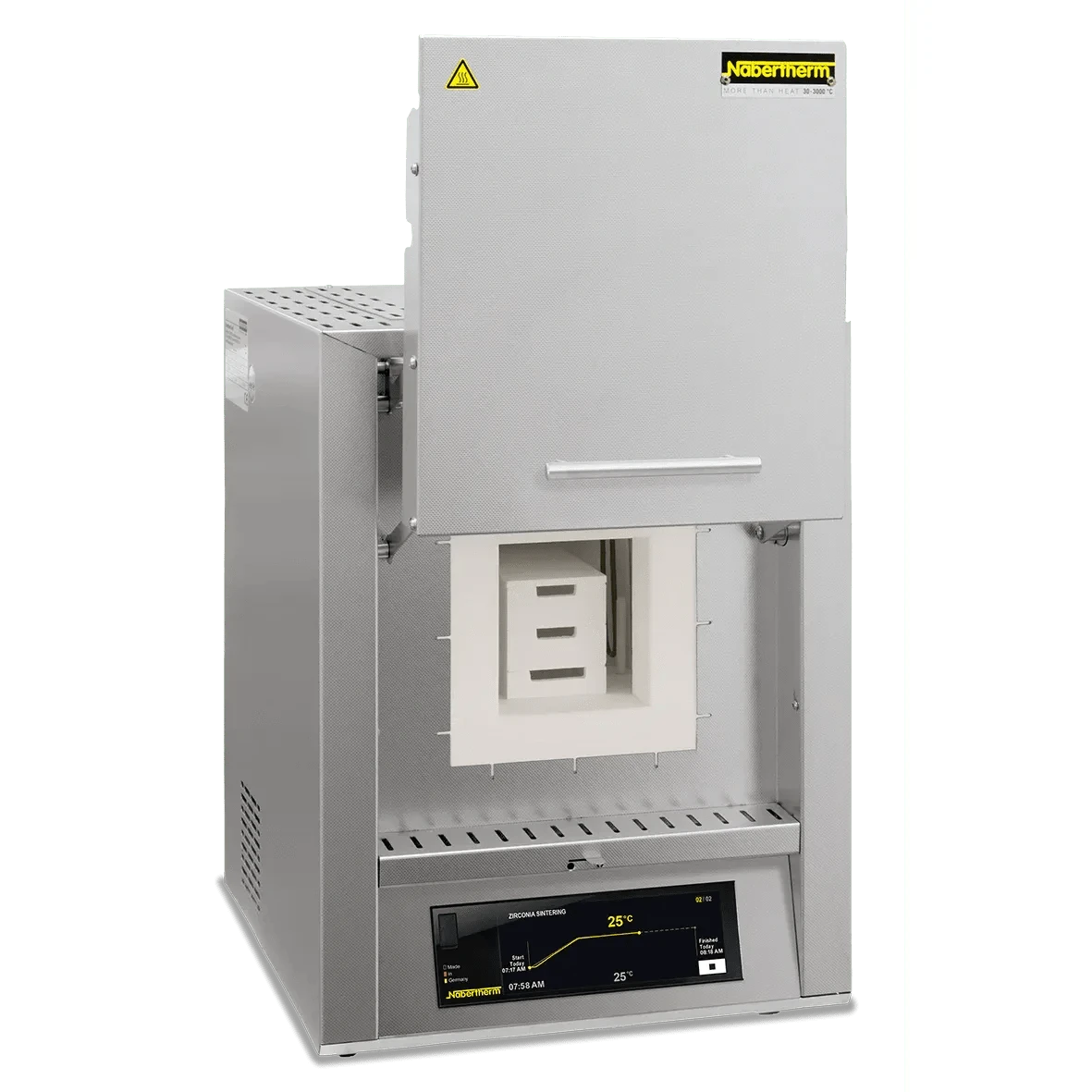
Getting the dental furnace settings right is a process, not a single number.
If your remakes are climbing and you suspect the furnace rather than the material, we can help you find out.
Frequently Asked Questions
What temperature should zirconia be sintered at?
Most translucent dental zirconia sinters between 1450°C and 1550°C, . The figure that matters is the one in your blank manufacturer's instructions, because peak temperature controls density, shrinkage and final translucency. Always program the furnace to the blank supplier's curve rather than a generic schedule, and confirm the chamber actually reaches that temperature with a calibration ring.
Can zirconia restorations be rapid-sintered?
Rapid sintering zirconia is possible, but only with materials and furnaces rated for it. Speed cycles shorten the ramp and hold stages and rely on forced cooling, on furnaces built for it. Not every zirconia grade tolerates the faster curve. Check the blank instructions before using a speed program, and validate the outcome on a test unit before committing a case.
How can I check whether a dental sintering furnace is calibrated?
Run a calibration ring or test sinter through the furnace on the program you use most, then inspect the fired result for chalky patches or distortion. Record the result against the date so drift becomes visible over months rather than after a failed case. If the test unit falls outside the expected tolerance, arrange a service calibration before running production work.
What happens if zirconia is sintered at the wrong temperature?
Too low a peak leaves the restoration under-sintered: chalky, weak and prone to chipping, with poor shade development. Too high a peak can overfire the surface and reduce translucency. Because the damage is set once the cycle finishes, the only reliable fix is to correct the program and remake the unit.


