


Last Updated: November 17, 2026
Quick Summary
CAD/CAM dental crowns are tooth-shaped caps designed on a computer and milled from a solid ceramic block, rather than cast by hand in a lab. The workflow has three stages: scan, design, mill, with each stage replacing a slower manual step.
- Digital impressions replace tray and putty with an intraoral scanner that builds a 3D image.
- Tooth preparation happens before any scan and decides how well the final restoration fits.
- Zirconia, lithium disilicate and porcelain are the three main CAD/CAM crown materials.
- Same-day crowns suit straightforward single-tooth cases, not complex bite changes.
- Margin leakage is the most common long-term failure point for a crown.
Table of Contents
- What CAD/CAM Dental Crowns Actually Are
- How Digital Dental Impressions Replace the Tray and Putty
- Tooth Preparation: What Has to Happen Before the Scan
- Dental Crown Milling: From Virtual Model to Ceramic Block
- Materials: Zirconia, Lithium Silicate and Porcelain Compared
- Same-Day CAD/CAM Crowns: Who They Suit and Who They Don't
- Costs, Longevity and the Limits of the Digital Workflow
- Equipping a Lab for CAD/CAM Crown Production
- Frequently Asked Questions
What CAD/CAM Dental Crowns Actually Are
CAD/CAM dental crowns are tooth-shaped caps designed on a computer and milled from a solid ceramic block, rather than cast by hand in a lab. The letters stand for computer-aided design and computer-aided manufacturing.
The workflow has three stages: scan, design, mill. Each stage replaces a slower manual step.
Design and manufacturing, in plain terms
Computer-aided design is where software turns a 3D scan into a virtual model of the crown. The technician shapes the restoration on screen, checking margins and bite before anything is cut.
Computer-aided manufacturing is where a milling unit carves the finished shape from a ceramic block, no wax pattern, no casting, no hand-layering.
The result is a prosthesis built to a digital plan. That plan is only as good as the scan feeding it.
How Digital Dental Impressions Replace the Tray and Putty
Digital dental impressions replace the tray and putty with an intraoral scanner that builds a 3D image of the prepared tooth and surrounding soft tissue.
The advantages are practical:
- No gag reflex from a loaded tray
- No bubbles or tears to remake the impression
- The file sends to the lab instantly
What most guides miss is the soft tissue problem. Moisture, blood and a deep margin can all blur the scan.
For a deeper look at margin capture accuracy, our guide to 3D scanners for dental margins covers what to check before you buy.
Tooth Preparation: What Has to Happen Before the Scan
Tooth preparation is the step where the dentist reduces the tooth to make room for the crown.
A common mistake is under-reducing the tooth: too little enamel removed leaves the crown thin or bulky, and the fit suffers either way.
Bite clearance matters too. The prepared tooth needs enough space for the restorative material to sit without sitting high in occlusion.
Dental Crown Milling: From Virtual Model to Ceramic Block
Dental crown milling is the process where a milling machine carves the crown from a ceramic block using rotating burs. The design file drives the machine, and the burs cut the shape layer by layer until the restoration is complete.
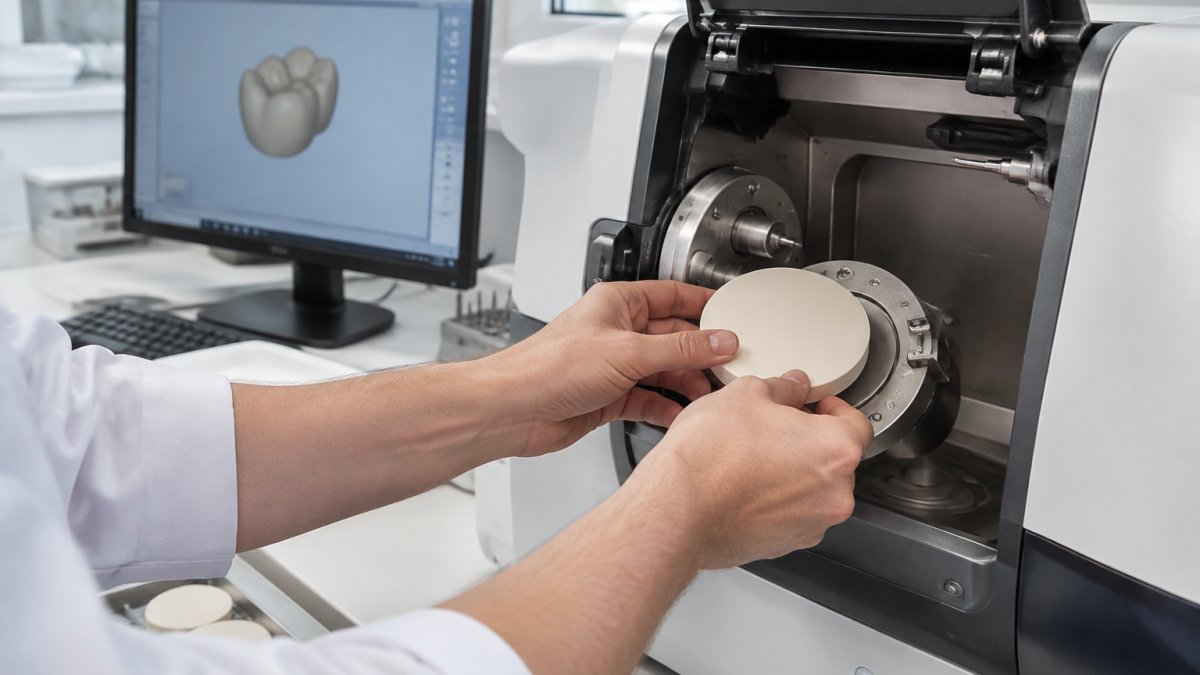
The technician nests the crown inside the block to use material efficiently. Then the milling unit takes over.
The burs, the block and the fit check
The bur is the cutting tool, and it wears out. A dull bur produces chipped margins and poor surface finish. Change burs on schedule, not when a crown fails.
After milling, the crown is sintered, finished and tried on. The fit check confirms the marginal seal and the bite before cementation. Our Paragon milling tool range shows the bur types used at each stage.

Materials: Zirconia, Lithium Silicate and Porcelain Compared
Zirconia, lithium disilicate and porcelain are the three main CAD/CAM crown materials, and each suits different cases. The choice is not about which material is "best" in the abstract, it is about matching strength, appearance and bonding requirements to the tooth being restored.
| Material | Strength | Best For | Trade-off |
|---|---|---|---|
| Zirconia | Very high | Molars, bridges, full arch | Less translucent |
| Lithium disilicate | High | Single crowns, front teeth | Needs bonding care |
| Porcelain | Lower | High-aesthetic cases | More fragile |
Zirconia: the workhorse for load-bearing teeth
Zirconia is a polycrystalline ceramic that is generally regarded as having high flexural strength, which is why it is commonly used for molars and load-bearing crowns.
The trade-off is optical. Early zirconia was opaque and chalky; modern multilayer discs have narrowed that gap, but a monolithic zirconia crown on a central incisor still reads flatter than a layered ceramic.
A practical point most guides skip: zirconia needs adequate occlusal reduction.
Lithium disilicate: the aesthetic single-unit choice
Lithium disilicate sits between zirconia and porcelain. It is strong enough for single crowns anywhere in the mouth, including premolars, and its translucency is close enough to natural enamel that it is the common choice for anterior single crowns and veneer-adjacent work.
The catch is bonding. A clinician who cements one like a metal crown will see more debonds and fractures over time: a technique issue, not a material failure, but it shows up in the crown's lifespan all the same. (Source: Medicines and Healthcare products Regulatory Agency guidance on medical devices)
Porcelain: aesthetics first, strength second
Porcelain (feldspathic or leucite-reinforced) gives the best optical result of the three, particularly where a technician can layer it to mimic the natural tooth's shade and translucency gradients.
Porcelain is best reserved for high-aesthetic anterior cases with favourable occlusion and no full load-bearing requirement. Where those conditions are not met, a layered zirconia or lithium disilicate crown usually gives a better long-term balance.
How the decision is actually made
In practice, the material choice comes down to four questions:
- Where is the tooth? Anterior teeth favour translucency; posterior teeth favour strength.
- How much tooth structure remains after preparation? A heavily reduced tooth needs a material that tolerates the resulting thickness.
- What are the bite forces? Bruxism, a deep bite or a history of fractured restorations push the choice toward zirconia.
Multilayer zirconia has narrowed the gap between strength and aesthetics. Our NOBILCAM MM-4D multilayer zirconia discs blend shade and opacity through the disc, so a monolithic crown reads more like a natural tooth without giving up the strength of a full-zirconia restoration.
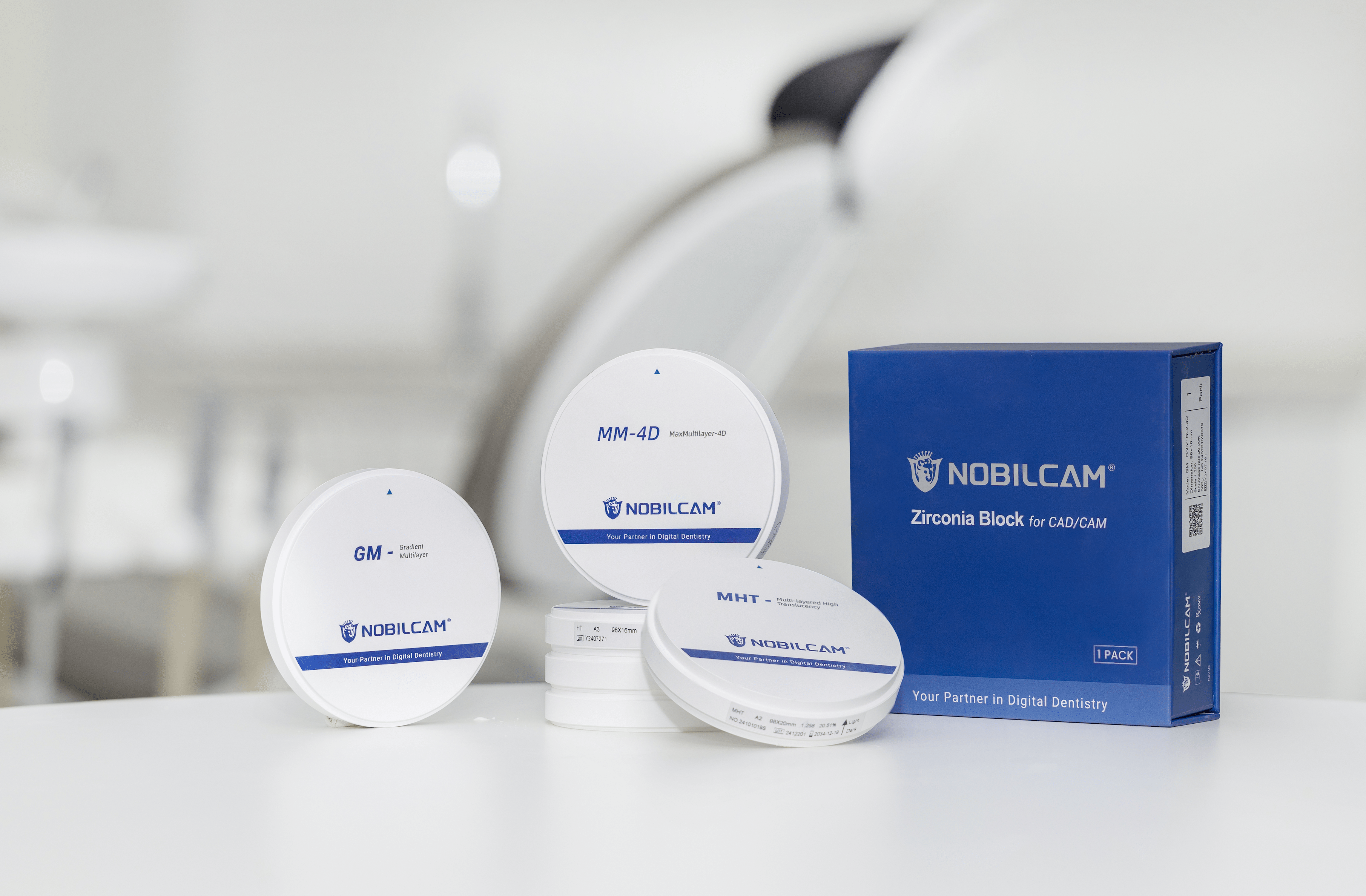
Watch out: choosing a material by brand name alone, without checking the block's strength class and intended indication, is how a crown ends up in the wrong part of the mouth. Match the block to the tooth, not the marketing.
Same-Day CAD/CAM Crowns: Who They Suit and Who They Don't
Same-day CAD/CAM crowns suit straightforward single-tooth cases where the tooth can be prepared, scanned and milled in one visit.
Good candidates typically include a single broken or heavily filled back tooth, adequate healthy tooth structure after preparation, and a patient who can sit through a longer appointment.
For these, a conventional two-visit pathway with a temporary crown often gives a better result.
Costs, Longevity and the Limits of the Digital Workflow
Costs for CAD/CAM crowns vary by practice, material and complexity, and we would not quote a figure that a clinic has not confirmed. What we can do is explain what drives the fee, so a patient can read an estimate and understand it.
What drives the cost of a CAD/CAM crown
The fee a practice charges reflects several inputs:
- Material. A zirconia crown and a layered porcelain crown use different blocks and different amounts of technician time, and the material cost difference is real even if the patient-facing fee is often smoothed.
- Chair time. A same-day crown concentrates the work into one longer appointment; a conventional two-visit pathway spreads it across two shorter ones.
- Complexity. A straightforward posterior single unit is at the simple end; a crown on a tooth with a deep subgingival margin, a core build-up, or a bite that needs reorganising sits at the complex end.
Ask your dentist for a written estimate before treatment starts, and check what your dental plan covers. Check with your dental plan what it covers, as cover for crowns varies by plan.
Realistic longevity and the factors that move it
Longevity depends on material, bite forces and oral hygiene. A well-fitted crown on a well-cared-for tooth can last many years; a crown on a tooth with active gum disease or heavy bruxism will not. Rather than quote a single number, it is more useful to understand the failure modes:
- Margin leakage. The seal between crown and tooth is the most common long-term failure point; a margin that is not fully seated or is exposed to plaque lets bacteria under the crown and decay at the tooth surface.
- Chipping and fracture. Ceramic can chip at the margin or fracture under heavy load; zirconia resists this better than porcelain, and a thin porcelain crown on a molar is the classic failure case.
- Cement washout. Cement at the margin can dissolve or wear away over time, opening a path for leakage; good marginal fit and regular review reduce the risk.
Regular reviews, good oral hygiene and addressing bruxism (with a night guard where indicated) do more for crown lifespan than any single material choice.
The limits of the digital workflow
The digital workflow has limits worth knowing:
- Scanners struggle with moisture and deep subgingival margins. Blood, saliva and a margin below the gum line can degrade the scan, and a degraded scan produces a crown that does not seat.
- Milling units cannot match the fine layering of a skilled ceramicist. A monolithic milled crown is strong and efficient, but a highly aesthetic anterior case may still benefit from layered characterisation a mill cannot produce in one pass.
- Software errors can pass into the final crown if the design is not checked. Margin, contacts and occlusion are set at the design stage, so an error not caught on screen becomes a physical error in ceramic.
Quality checks at each stage catch most of these. Skipping them does not. The practical takeaway for a patient is to ask what material is being used, whether the crown is being milled in-house or sent to a lab, and what the practice's policy is if the crown needs adjusting or remaking.
Watch out: a fee that looks low can reflect a material or a pathway that was not explained. The estimate should name the material and the number of visits, not just the total.
Equipping a Lab for CAD/CAM Crown Production
Equipping a lab for CAD/CAM crown production means matching scanner, software, milling unit and sintering capacity to your case volume.
A small lab running modest weekly case numbers does not need a high-capacity mill.
A common mistake is overbuying the mill and underbuying the support.
Our small dental lab equipment checklist walks through what to plan for. If you want to see the equipment in a working lab before you commit, book a visit to our milling centre and we will show you the workflow end to end.
Choosing a CAD/CAM setup is a decision about accuracy, uptime and support, not just a machine on a bench.
Frequently Asked Questions
Are CAD/CAM dental crowns as strong as traditional crowns?
Strength depends on the material rather than the manufacturing route. Milled zirconia is among the strongest crown ceramics available, and multilayer discs such as Nobilcam MM-4D reach flexural strengths of 700 to 1200 MPa, which covers single crowns through to long-span bridges. Lithium disilicate gives excellent aesthetics at lower strength, so it suits front teeth and single units. A traditional lab-made crown in the same ceramic performs comparably; the difference is the workflow, not an inherent weakness.
How long does a CAD/CAM crown take from scan to fit?
Sintering or crystallisation adds time depending on the material, so timings vary by case and material; ask your dentist for the expected appointment length. Where a case needs a try-in, shade work or complex occlusion, the crown is produced across two appointments and the patient leaves the first with a temporary.
Can every tooth be restored with a same-day CAD/CAM crown?
No. Same-day CAD/CAM crowns work best on single posterior teeth with straightforward preparation and a clean margin. Cases that often need a conventional two-stage route include heavy cosmetic work where shade matching is critical, implants needing soft tissue contouring, very short clinical crowns, and patients with limited opening or uncontrolled moisture. Your dentist should assess the tooth and explain which route applies before treatment starts.
What materials are used for dental crown milling?
Most milled crowns use zirconia, lithium disilicate or feldspathic porcelain, supplied as CAD/CAM blocks or discs. Zirconia dominates posterior and bridge work for its strength and now comes in multilayer formats that blend shade and translucency through the thickness. Lithium disilicate is chosen for anterior aesthetics. The milling burs matter too: a 2.5mm ball bur on a 3mm shank handles standard zirconia work, while finer 1mm tools are used for detailed anatomy.


